spring_greetings photo springgreetings.gif
Showing posts with label history. Show all posts

Thursday, July 4, 2013

Independence day


"Our lives, our fortunes, our sacred honor"
by Rush H. Limbaugh, Jr.

It was a glorious morning. The sun was shining and the wind was from the southeast. Up especially early, a tall bony, redheaded young Virginian found time to buy a new thermometer, for which he paid three pounds, fifteen shillings. He also bought gloves for Martha, his wife, who was ill at home.

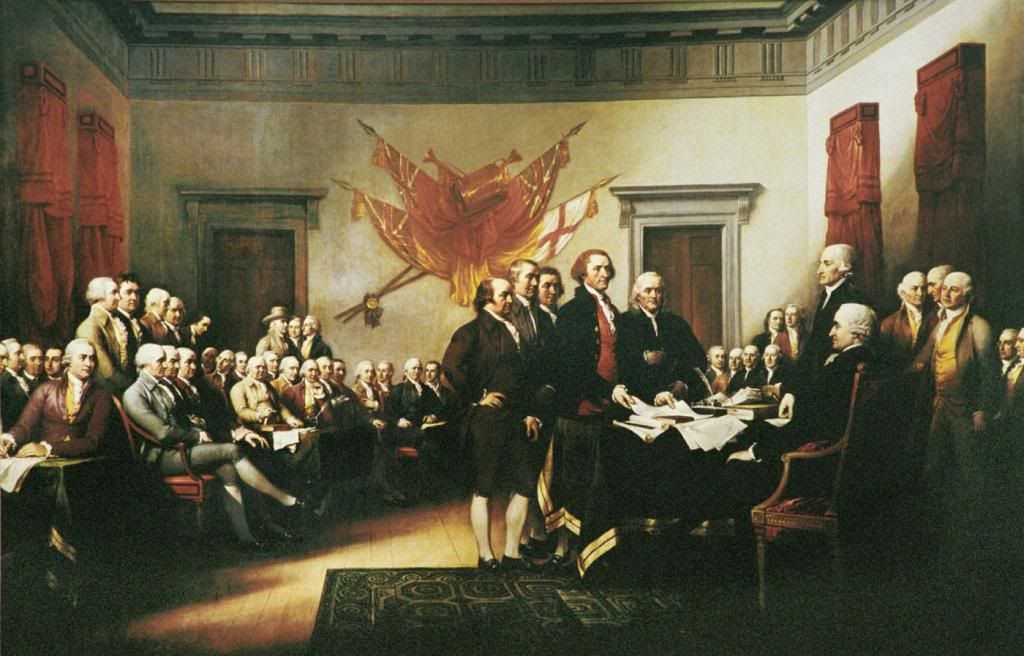
Thomas Jefferson arrived early at the statehouse. The temperature was 72.5 degrees and the horseflies weren't nearly so bad at that hour. It was a lovely room, very large, with gleaming white walls. The chairs were comfortable. Facing the single door were two brass fireplaces, but they would not be used today.

The moment the door was shut, and it was always kept locked, the room became an oven. The tall windows were shut, so that loud quarreling voices could not be heard by passersby. Small openings atop the windows allowed a slight stir of air, and also a large number of horseflies. Jefferson records that "the horseflies were dexterous in finding necks, and the silk of stocking was nothing to them." All discussion was punctuated by the slap of hands on necks.

On the wall at the back, facing the President's desk, was a panoply-consisting of a drum, swords, and banners seized from Fort Ticonderoga the previous year.

Ethan Allen and Benedict Arnold had captured the place, shouting that they were taking it "in the name of the Great Jehovah and the Continental Congress!"

Now Congress got to work, promptly taking up an emergency measure about which there was discussion but no dissention. "Resolved: That an application be made to the Committee of Safety of Pennsylvania for a supply of flints for the troops at New York."

Then Congress transformed itself into a committee of the whole. The Declaration of Independence was read aloud once more, and debate resumed. Though Jefferson was the best writer of all of them, he had been somewhat verbose. Congress hacked the excess away.

They did a good job, as a side-by-side comparison of the rough draft and the final text shows. They cut the phrase "by a self-assumed power." "Climb" was replaced by "must read," then "must" was eliminated, then the whole sentence, and soon the whole paragraph was cut.

Jefferson groaned as they continued what he later called "their depredations." "Inherent and inalienable rights" came out "certain unalienable rights," and to this day no one knows who suggested the elegant change.

A total of 86 alterations were made. Almost 500 words were eliminated, leaving 1,337. At last, after three days of wrangling, the document was put to a vote.

Here in this hall Patrick Henry had once thundered: " I am no longer a Virginian, Sir, but an American." But today the loud, sometimes bitter argument stilled, and without fanfare the vote was taken from north to south by colonies, as was the custom. On July 4, 1776, the Declaration of Independence was adopted.

There were no trumpets blown. No one stood on his chair and cheered. The afternoon was waning and Congress had no thought of delaying the full calendar of routine business on its hands. For several hours they worked on many other problems before adjourning for the day.

Much To Lose

What kind of men were the 56 signers who adopted the Declaration of Independence and who, by their signing, committed an act of treason against the crown? To each of you the names Franklin, Adams, Hancock, and Jefferson are almost as familiar as household words.

Most of us, however, know nothing of the other signers.

Who were they? What happened to them?

I imagine that many of you are somewhat surprised at the names not there: George Washington, Alexander Hamilton, Patrick Henry. All were elsewhere.

Ben Franklin was the only really old man. Eighteen were under 40; three were in their 20s. Of the 56 almost half -24- were judges and lawyers. Eleven were merchants, 9 were landowners and farmers, and the remaining 12 were doctors, ministers, and politicians.

With only a few exceptions, such as Samuel Adams of Massachusetts, these were men of substantial property.

All but two had families. The vast majority were men of education and standing in their communities. They had economic security as few men had in the 18th century.

Each had more to lose from revolution than he had to gain by it. John Hancock, one of the richest men in America, already had a price of 500 pounds on his head.

He signed in enormous letters so "that his Majesty could now read his name without glasses and could now double the reward." Ben Franklin wryly noted: "Indeed we must all hang together, otherwise we shall most assuredly hang separately." Fat Benjamin Harrison of Virginia told tiny Elbridge Gerry of Massachusetts: "With me it will all be over in a minute, but you , you will be dancing on air an hour after I am gone.

These men knew what they risked. The penalty for treason was death by hanging. And remember: a great British fleet was already at anchor in New York Harbor.

They were sober men. There were no dreamy-eyed intellectuals or draft card burners here. They were far from hot-eyed fanatics, yammering for an explosion.

They simply asked for the status quo. It was change they resisted. It was equality with the mother country they desired. It was taxation with representation they sought. They were all conservatives, yet they rebelled.

It was principle, not property, that had brought these men to Philadelphia. Two of them became presidents of the United States. Seven of them became state governors. One died in office as vice president of the United States. Several would go on to be U.S. Senators.

One, the richest man in America, in 1828 founded the Baltimore and Ohio Railroad. One, a delegate from Philadelphia, was the only real poet, musician and philosopher of the signers (it was he, Francis Hopkinson - not Betsy Ross who designed the United States flag).

Richard Henry Lee, A delegate from Virginia, had introduced the resolution to adopt the Declaration of Independence in June of 1776. He was prophetic in his concluding remarks:

"Why then sir, why do we longer delay? Why still deliberate? Let this happy day give birth to an American Republic. Let her arise not to devastate and to conquer but to reestablish the reign of peace and law. The eyes of Europe are fixed upon us. She demands of us a living example of freedom that may exhibit a contrast in the felicity of the citizen to the ever increasing tyranny which desolates her polluted shores. She invites us to prepare an asylum where the unhappy may find solace, and the persecuted repost. If we are not this day wanting in our duty, the names of the American Legislatures of 1776 will be placed by posterity at the side of all of those whose memory has been and ever will be dear to virtuous men and good citizens."

Though the resolution was formally adopted July 4, it was not until July 8 that two of the states authorized their delegates to sign, and it was not until August 2, that the signers met at Philadelphia to actually put their names to the Declaration.

William Ellery, delegate from Rhode Island, was curious to see the signers' faces as they committed this supreme act of personal courage. He saw some men sign quickly, "but in no face was he able to discern real fear."

Stephan Hopkins, Ellery's colleague from Rhode Island, was a man past 60. As he signed with a shaking pen, he declared: "My hand trembles, but my heart does not."

"Most glorious service"

Even before the list was published, the British marked down every member of Congress suspected of having put his name to treason. All of them became the objects of vicious manhunts. Some were taken. Some, like Jefferson, had narrow escapes. All who had property or families near British strongholds suffered.

- Francis Lewis, New York delegate saw his home plundered and his estates in what is now Harlem, completely destroyed by British soldiers. Mrs. Lewis was captured and treated with great brutality. Though she was later exchanged for two British prisoners though the efforts of Congress she died from the effects of her abuse.

- William Floyd, another New York delegate, was able to escape with his wife and children across Long Island Sound to Connecticut, where they lived as refugees without income for seven years. When they came home they found a devastated ruin.

- Philips Livingstone had all his great holdings in New York confiscated and his family driven out of their home. Livingstone died in 1778 still working in Congress for the cause.

- Louis Morris, the fourth New York delegate, saw all his timber, crops, and livestock taken. For seven years he was barred from his home and family.

- John Hart of Trenton, New Jersey, risked his life to return home to see his dying wife. Hessian soldiers rode after him, and he escaped in the woods. While his wife lay on her deathbed, the soldiers ruined his farm and wrecked his homestead. Hart, 65, slept in caves and woods as he was hunted across the countryside. When at long last, emaciated by hardship, he was able to sneak home, he found his wife had already been buried, and his 13 children taken away. He never saw them again. He died a broken man in 1779, without ever finding his family.

- Dr. John Witherspoon, signer, was president of the College of New Jersey, later called Princeton. The British occupied the town of Princeton, and billeted troops in the college. They trampled and burned the finest college library in the country.

- Judge Richard Stockton, another New Jersey delegate signer, had rushed back to his estate in an effort to evacuate his wife and children. The family found refuge with friends, but a Tory sympathizer betrayed them. Judge Stockton was pulled from bed in the night and brutally beaten by the arresting soldiers. Thrown into a common jail, he was deliberately starved. Congress finally arranged for Stockton's parole, but his health was ruined. The judge was released as an invalid, when he could no longer harm the British cause. He returned home to find his estate looted and did not live to see the triumph of the revolution. His family was forced to live off charity.

- Robert Morris, merchant prince of Philadelphia, delegate and signer, met Washington's appeals and pleas for money year after year. He made and raised arms and provisions which made it possible for Washington to cross the Delaware at Trenton. In the process he lost 150 ships at sea, bleeding his own fortune and credit almost dry.

- George Clymer, Pennsylvania signer, escaped with his family from their home, but their property was completely destroyed by the British in the Germantown and Brandywine campaigns.

- Dr. Benjamin Rush, also from Pennsylvania, was forced to flee to Maryland. As a heroic surgeon with the army, Rush had several narrow escapes.

- John Martin, a Tory in his views previous to the debate, lived in a strongly loyalist area of Pennsylvania. When he came out for independence, most of his neighbors and even some of his relatives ostracized him. He was a sensitive and troubled man, and many believed this action killed him. When he died in 1777, his last words to his tormentors were: "Tell them that they will live to see the hour when they shall acknowledge it [the signing] to have been the most glorious service that I have ever rendered to my country."

- William Ellery, Rhode Island delegate, saw his property and home burned to the ground.

- Thomas Lynch, Jr., South Carolina delegate, had his health broken from privation and exposures while serving as a company commander in the military. His doctors ordered him to seek a cure in the West Indies and on the voyage he and his young bride were drowned at sea.

- Edward Rutledge, Arthur Middleton, and Thomas Heyward, Jr., the other three South Carolina signers, were taken by the British in the siege of Charleston. They were carried as prisoners of war to St. Augustine, Florida, where they were singled out for indignities. They were exchanged at the end of the war, the British in the meantime having completely devastated their large landholdings and estates.

- Thomas Nelson, signer of Virginia, was at the front in command of the Virginia military forces. With British General Charles Cornwallis in Yorktown, fire from 70 heavy American guns began to destroy Yorktown piece by piece. Lord Cornwallis and his staff moved their headquarters into Nelson's palatial home. While American cannonballs were making a shambles of the town, the house of Governor Nelson remained untouched. Nelson turned in rage to the American gunners and asked, "Why do you spare my home?" They replied, "Sir, out of respect to you." Nelson cried, "Give me the cannon!" and fired on his magnificent home himself, smashing it to bits. But Nelson's sacrifice was not quite over. He had raised $2 million for the Revolutionary cause by pledging his own estates. When the loans came due, a newer peacetime Congress refused to honor them, and Nelson's property was forfeited. He was never reimbursed. He died, impoverished, a few years later at the age of 50.

Lives, fortunes, honor

Of those 56 who signed the Declaration of Independence, nine died of wounds or hardships during the war. Five were captured and imprisoned, in each case with brutal treatment. Several lost wives, sons or entire families. One lost his 13 children. Two wives were brutally treated. All were at one time or another the victims of manhunts and driven from their homes.

Twelve signers had their homes completely burned.

Seventeen lost everything they owned. Yet not one defected or went back on his pledged word. Their honor, and the nation they sacrificed so much to create is still intact.

And, finally, there is the New Jersey Signer, Abraham Clark.

He gave two sons to the officer corps in the Revolutionary Army. They were captured and sent to that infamous British prison hulk afloat in New York Harbor known as the hell ship "Jersey," where 11,000 American captives were to die. The younger Clarks were treated with a special brutality because of their father.

One was put in solitary and given no food. With the end almost in sight with the war almost won, no one could have blamed Abraham Clark for acceding to the British request when they offered him his sons' lives if he would recant and come out for the King and Parliament. The utter despair in this man's heart, the anguish in his very soul, must reach out to each and one of us down through 200 years with the answer: "No."

The 56 signers of the Declaration of Independence proved by their every deed that they made no idle boast when they composed the most magnificent curtain line in history. "And for the support of this Declaration with a firm reliance on the protection of divine providence, we mutually pledge to each other our lives, our fortunes, and our sacred honor."

- Rush H. Limbaugh, Jr.


books

Wednesday, January 18, 2012

America: The Last Best Hope Vol. III by William J. Bennett


William Bennett has done it again; he has put together information to inform his readers. I have many of Bennett's books both adult and children's and like them this book was not a disappointment. This is this third book in America series it enlightens the reader to the last 20 years of American history:  From the collapse of Communism to the Rise of radical Islam.  It covers presidents from George H. Bush to beginning of Obama's presidency.  This book was very interesting for the history buff and informative for the political/history wannabes.  The author presents the information in a very easy to read format that is easy to read and follow, Bennett keeps the readers interest sparked.   The author adds his own personal notes, views, and perspectives throughout the book.  Many schools use Bennett's books in their curriculum.  I highly recommend this book for anyone who wants to be informed.  You will walk away more informed after reading Bennett's book.


for more information about this book visit here

a copy of this book was provided by Thomas Nelson in exchange for my honest review

I review for BookSneeze®


books

Friday, November 4, 2011

Just Fine the Way They Are by Connie Nordhielm Wooldridge


Learn how the world of transportation has changed from dirt roads to rail roads to interstates.   This was a very fun book to read.  Travel cross country as you see the world open wide before your eyes in this children's book Just Fine the Way They Are by Connie Nordhielm Wooldridge.  This book will not only entertain, but educate your child as you read how the stuck-in-the-mud dirt road evolves into a busy lane of interstate across the country.  Can horses, bikes, cars and trains all travel on the same road?  Must they each have their own road?  How can we get there faster?  It's all in this wonderful book by Wooldridge.  The illustrations are just as eye catching as the method of how the road system came into being.

Book blurb~
"But most folks didn't agree with John Slack's bad opinion of the National Road. Most folks thought it was a real fine thing. They thought it was the Main Street of America, where ideas and people and things to sell moved back and forth across the country. Living near the National Road was pure excitement."


This is more than a story about transportation. Just Fine The Way They Are: From Dirt Roads to Rail Roads to Interstates is also a story about change and resistance, progress and protest, innovation and the American entrepreneurial spirit. Author Connie Nordhielm Wooldridge and artist Richard Walz worked closely with experts and firsthand accounts to tell a "just fine and accurate" illustrated story of how dirt roads of the 1800s turned into the U.S. highway system of today. Just Fine The Way They Are is the fifth picture book by Wooldridge who also earned critical acclaim for her young adult biography of Edith Wharton, The Brave Escape of Edith Wharton (Clarion 2010).

A special plus for educators and home school instructors are three sets of lesson plans and teacher resources Wooldridge developed with two elementary school teachers. These are available to download from her website at no cost.

Critics agree on the importance of engaging children in discussing the subject of transportation -"a fine philosophical debate to introduce to budding environmentalists" (Los Angeles Times, July 3, 2011). Roundtable Reviews for Kids writes, "As young readers follow the development of these basic ground transportation systems, they'll discover the importance of those people who not only invent new ways of doing things, but also refuse to give in when obstacles are placed in their way." The author, who lives near the National Road, now I-40, in Richmond, Indiana, provides resources for those readers who want to learn more, including a timeline, bibliography, websites, historic landmarks and places to visit.

The story begins with Mr. John Slack, the keeper of a tavern beside a rutted dirt road in the early 1800s, who thought things were just fine the way they were. Lucius Stockton, who ran the National Road Stage Company in the mid 1800s agreed, and so too did the owners of the railroads when the first Model T appeared in 1908. Yet with each new innovation, driven by Americans need to move around the country more quickly, efficiently, comfortably, and now more "greenly," means things will never be just fine the way they are. Richard Walz, who has illustrated numerous non-fiction titles for children, "provides heroic imagery with a Thomas Hart Benton twang" (Kirkus Reviews, February 11, 2011).

learn more about the book here

Connie Nordhielm Wooldridge's vivid imagination and spirited storytelling are fueled by her love of travel, adventure, and the unconventional way she embraces all life has to offer. She's lived in seven states, Washington, D.C., Athens, Greece and Seoul; was a Latin major, a flight attendant for a major airline, raised four children who are five years apart in age, and worked at a job she'd dreamed of having as a little girl - a librarian in an elementary school. While attending the University of Chicago graduate school, where she received a double Masters degree in library science and education, she was recommended by Zena Sutherland, children's literature professor and editor of The Bulletin for the Center of Children's Books, to serve first on the American Library Association's Newbery-Caldecott Committee and then on the Notable Books Committee. In addition to her five non-fiction picture books for children and a young adult biography The Brave Escape of Edith Wharton (Clarion Books, August 2010), she's written numerous articles and stories for Highlights for Children and Cricket. Her first book, Wicked Jack (Holiday House 1995) won the Irma S. and James H. Black Book Award and North Carolina Children's Book Award, and The Legend of Strap Buckner (Holiday House 2001) earned the Spur Award from the Western Writers of America.

visit the author's web site here.

A copy of this book was provided by the author and Bostick Communications for the purpose of this review.

books

Wednesday, December 8, 2010

The Twelve Days of Christmas in GEORGIA by Susan Rosson Spain


Today I thought I'd post about a cute book that I won about 6 weeks ago.  I was so excited when I learned I won a copy of this book.  Georgia is just one of the states that has already been published (See a listing of other books in this series here)  The Twelve days of Christmas follows the song (with word changed) with this particular book the author takes the reader to sites around the state of Georgia.  Sh! don't tell the reader, but the reaader is learning while reading this catchy little rhyming book.  Fun facts about Georgia are learned as you travel with Jacob and his cousin, Ava.  Each day takes them on a new adventure and gives them a new  learning experience.  At the end of the day Jacob writes his parents a note telling them about the fun he is having while visiting his cousin in Georgia and what he is learning. The illustrations of this book are just as catchy as the rhythm. 

Books and learning last ~ give a book for Christmas. 

Visit The Twelve Days of Christmas in Georgia website for fun activities, recipe, downloads and more
The author tells of her research adventures for this book here.
Find other titles in this series here
Read an author interview here


NOTE: As mentioned above this book was one I won.  I was not paid or compensated in any way for this book review.  I just wanted to get the word out about this book.  The review is my own words, thoughts and opinions.


books

Wednesday, June 9, 2010

A Hopeful Heart by Kim Vogel Sawyer


Today I'm sending you over to my new web site to view this book tour.

Head over to Scraps of Life here take a look around, but know that it is new site just opened. I'm moving there from Lighter Side. add it to your favorites and be sure to stop by often.


books

Tuesday, May 18, 2010

Dawn's Prelude by Tracie Peterson

I think this is the first book I've read of Tracie's; however, she's no stranger in our house. My teenage daughter loves Tracie's books. So when this one came up for grabs to read and review I hooked it. Yes, I know it has taken me awhile to get it read, but I finally did. I was not disappointed either. I know why my daughter loves Tracie's books now. I'm now reading book two in the series and book three is coming out for review in August so I'll hook that one too.

If you want an page turner then this is the book for you. You won't be able to set the book down. What some people won't do to try to gain great power and make a name for them self in business. This book has it all in it: murder, kidnapping, mystery, adventure, suspense wrapped around romance. From devious acts of business to arranged marriages and evil acts of trying to get ahead. Theme: good versus evil. When it looks like the bad guy is on the up and up he tumbles down. Seems like in the end God always gets the victory.

It was a wonderful book and looking forward to book three. In the next few weeks I'll have the review for book two posted. It has proven to be just as good as book one so far. I'm about a third into the book.

Visit this books tour here.


books

Monday, March 1, 2010

A Century Turns by William J. Bennett


Book summery:
Author, historian, and educator William J. Bennett examines America’s last two decades. Volume Three of "America: The Last Best Hope", "A Century Turns" covers the years 1988-2008. Describing years of change, hope, and the beginning of decades we've yet to experience, discover the beginnings of some of today's most prominent people.

My Review:
William J. Bennett is back by popular demand. Now, Vol III of his US History curriculum. If you've been in the dark as to where America has come from the past 20 years, then this is the book for you. Mr. Bennett in his book, "A Century Turns", will bring it all to light for you. He is honest and up-front in his writings as to where we have come from. He'll hold your attention and make you think about where America may be heading in the future. The information he presents is very informative and well written a very pleasant read. The book has several sections of colorful photographs from the past 20 years mingled in with the reading materials. He is straight forward and very truthful in all his writing. He holds to a conservative view, which I liked very much. I do highly recommend it for anyone that really wants to know their history. Mr. Bennett's history books are used in many school throughout America. For educators/homeschoolers: you may check out Mr. Bennett's Road Map to America site here.

For more information on this book click here.

A copy of this book was provided by Thomas Nelson for this review.

I review for BookSneeze


books

Tuesday, December 1, 2009

World War II Heroes of Southern Delaware by James Diehl


My Review:
In this book you'll read about heroes who don't want that title. They claim, "they were just doing their job. or doing what they were told to do. " You'll read about the experiences, memories, emotions of these brave soldiers, seamen, Marines and defenders of our country. These Veterans share their memories and experiences of Iwo Jima, D-Day, Pearl Harbor and much more. It's first hand accounts from 48 men and 2 women with many of them sharing painful memories. "These memories needed to be penned because WWII veterans are becoming rare," says Diehl several men have passed away since Diehl's interview with them. Diehl made notation of those men. Many of these men were in life or death situations; it was kill or be killed. They received training for their physical body, but nothing could prepare them for the mental anguish they had to endure. Many recall seeing buddies and comrades fall to enemy fire. These vets are from very diverse positions and very much decorated. I don't think there was one that didn't have at least three stars, medals or awards after leaving their position of service to their country.

Diehl did an excellent job compiling these stories into this book. At the beginning of each chapter, Diehl gives a brief bio of the man (or) woman and their position title. I totally enjoyed reading about these that sacrificed for a cause; their ( our) country, their ( our) freedom. I raise an American flag to this author and these that he honored in this book.


Read the author's Christmas memories here.


World War II Heroes of Southern Delaware is a book unlike any other ever written. In its pages are profiles of 50 ordinary Americans who did extraordinary things during a time unlike any other in American history.

These are men and women who today call southern Delaware home. In the 1940s, these brave Americans put their lives on hold to fight for freedom and democracy against the horrific threat imposed on the world by Emperor Hirohito of Japan and German Fuhrer Adolph Hitler.

When Imperial Japan attacked the United States naval base at Pearl Harbor, Hawaii, on Dec. 7, 1941, the world changed forever. These men and women were a big part of that change; they fought to protect our freedom and our way of life.

Among the amazing stories you’ll read in “World War II Heroes of Southern Delaware” are:

  • A United States Marine who was a part of the 1945 attack on the Japanese island of Iwo Jima. He was one of 17 members of his company who survived, a company that numbered more than 300 at the beginning of the attack.
  • An Army soldier who was responsible for uncovering Adolph Hitler’s enormous, and illegally gained, fortune toward the end of World War II.
  • An Army navigator who led a group of 500 B-29s over Tokyo Bay on Sept. 2, 1945, the day the Japanese surrendered to the United States.
  • A United States Navy machinist’s mate who narrowly survived a Japanese kamikaze attack.
  • A United States Marine who witnessed the horrific attack on Pearl Harbor from the deck of a nearby ship.
  • Men who survived German prisoner of war camps.
  • First–hand accounts from the beaches of Normandy during the D-Day invasion.
  • Two black soldiers who served their country with pride during World War II.
  • Men who liberated German concentration camps.
  • A woman who served her country by becoming a part of the “Rosie the Riveter” movement.
  • And much, much more.

Readers of World War II Heroes of Southern Delaware will also receive a bonus section on Fort Miles, the immense, heavily fortified military facility built to protect the mouth of the Delaware Bay and the city of Philadelphia from an attack by the German navy. Today, the fort is being renovated and will soon become one of the largest World War II museums in the country.


James Diehl is an award-winning journalist who has covered Sussex County, Delaware for various media outlets since 1998. Since 2007, he has owned and operated a freelance writing company based in Seaford, Delaware and is also a partner in a Lewes, Delaware-based public relations and marketing firm. He is the author of one other work of non-fiction – “Remembering Sussex County, from Zwaanendael to King Chicken,” published in 2009 by The History Press. James lives in Seaford, Delaware, with his wife and two daughters. You can visit his website at www.ww2-heroes.com.


Ed Roberts will never forget the day American tanks rolled into Moosburg, Germany – more specifically into “the hole” the Germans called Stalag 7-A, a prisoner of war camp where the Pennsylvania native spent nine months as a guest of the German government during World War II.

It was, as a fellow prisoner later penned in his memoirs, a day when he saw 10,000 men cry. “You just can’t imagine the joy we felt after almost a year of making do under all kinds of situations,” Roberts says.

When American tanks rolled into the compound and started distributing K-rations, Roberts – who at the time was down to a mere 135 pounds – and his fellow prisoners started gobbling them down like they were candy.

“But after all that time, nothing tasted good,” he remembers.

As a prisoner of war in Germany, Roberts and his fellow captives called themselves kriegies – short for the German word kriegsgefangenan, which appropriately translates to “prisoner of war.”

As a kriegie, Roberts essentially had no rights. But when the American flag was raised over Moosburg in April, 1945, he realized his time in “German hell” was over.
Decades ago, former kriegies started the “Kriegie Klarion,” a monthly newsletter for those who suffered in German prisoner of war camps during World War II. Vernon L. Burda, who was in Stalag 7-A with Roberts, penned the following passage after the camp was liberated by American soldiers on April 29, 1945.

It still rings true to Roberts today.

“…for no apparent reason, a hush fell over the compound and all eyes turned toward the town in which stood two high church steeples. [More than] 20,000 eyes saw machine gun bullets splatter against the steeples – a period of quiet – and then it occurred. [It was] a scene, the happening of which brought tears streaming down the face of every single American prisoner of war there, and a sob from every throat.”

The passage continues: “We saw the greatest sight – the most emotional minute that we would probably ever witness. Raised before our eyes and flying defiantly above one of the church steeples was the symbol of our beloved land. The American flag!”

It was an emotional end to a fantastic journey that saw Roberts leave Pennsylvania State University and transverse the American landscape while training to become a fighter pilot. Joining the U.S. Army Air Corps on Nov. 11, 1942, all he ever wanted to do was fly.

“That was always my interest,” he says simply. “I took all kinds of physical and mental tests and, after that period, people in charge would say if you should be a pilot or a bombardier, or whatever. My classification was a fighter pilot.”

Roberts spent time training across the South, including stops at military facilities in Tennessee, Arkansas, Georgia, South Carolina, Alabama, Virginia and Florida. He even spent about a month flying P-47 Thunderbolts at Dover Army Airfield, now Dover Air Force Base. Finally, in the summer of 1944, he was sent to England and assigned to the 412th Squadron of the 373rd Fighter Group.

His unit was based on the beaches of Normandy following the D-Day invasion – Roberts says he’ll never forget the first time he flew over the famed beachhead.
“After the invasion, the Americans stayed in one place and they brought in all kinds of supplies,” says Roberts, who missed participating in the D-Day invasion by just two weeks. “Every free space on that beach was loaded down with supplies. It’s hard for people to understand the enormity of the whole thing. All we could see when flying over was hundreds of ships in the water and lots of supplies on the beaches.”

Taking off from Normandy to the south, Roberts says he would only be in the air for 400 to 500 yards before he was over enemy lines and, thus, taking enemy fire. He flew four missions before being shot down and taken prisoner – he still remembers it as if it was yesterday.


A copy of this book was provided for review by Virtual Book tours
Visit Virtual tours here


books

Tuesday, January 6, 2009

The American Patriot's Almanac by William J. Bennett and John T.E. Gribb

"Patriotism is more than just flying a flag," says William Bennett, "it's sticking it out through thick or thin (right or wrong.)" What do you know about America? Get to know your country better and love it more with William Bennett's help. This book is any history buff's dream. Good for the homeschooler too. Take a look at America daily with William Bennett's, The American Patriot's Almanac. This is a book of short daily readings of things that happened in America on that given day. It gives account of each day of the year. On a given day there is one main event that Mr. Bennett goes into detail on and then at the end of each day there is a History parade section that gives more events that can be looked up and studied about for those that wish more study. A lot of work and historical information is crammed into this book. It takes you day by day, and month by month through historical events through the year. The pages in this book tell the stories of heroes in uniform. It helps the reader see who we are as Americans. At the end of each month there is also a section of added information such has flag etiquette one month, fifty all-American movies to watch one month, learn about the great seal and what it stands for. The history of the flag and changes one month, and the list goes on. I could go on and on but I won't if you want a quick at your fingers history book this is your book.

It is a hardback book cover and the pages are rough edge to give it that old antique, scrapbook look. Very nicely done and would look nice just laying on the coffee table for quick read.


For more information click here.


books