spring_greetings photo springgreetings.gif
Showing posts with label holiday. Show all posts

Friday, April 18, 2014

Billy and the Monster who ate all the Easter Eggs by David Chuka

Billy and the monster who ate all the Easter eggs

About the Book

Title: Billy and The Monster Who Ate All The Easter Eggs | Author: David Chuka | Publication Date: March 23, 2013 | Publisher: Pen-n-a-Pad Publishing | Pages: 32 | Recommended Ages: 3 to 8 Summary: Join Billy and Monster in this third episode of the series titled Billy and the Monster who Ate All the Easter Eggs. Billy and Monster love all the holidays as they get to spend quality time together. However, their best holiday is Easter as they get to eat their favorite food...CHOCOLATE! This year, they're spending Easter with Grandma Chocalicious who loves Chocolate even more than Billy. She's an expert at making chocolate cake, chocolate waffles and even chocolate pasta. This year Grandma Chocalicious has made a pyramid of Easter eggs for her party on Easter Sunday. Billy and Monster want one of the Easter eggs but Grandma says they have to wait till Easter Sunday. What happens when Billy and Monster tip toe downstairs and the pyramid of Easter eggs comes falling down? Get your copy of this funny book for kids of all ages that is not only full of laughs but also has a lesson weaved in that you'll love sharing with your loved ones.  

Book Trailer


Purchase

* Print copy includes FREE coloring book inside *

Amazon (Print) | Amazon (Kindle)


The Buzz

"Experience is the best teacher as Billy and his "purple shadow" learn a sweet lesson in Billy and the Monster Who Ate All the Easter Eggs. Beautifully illustrated, nicely formatted, this quick, easy story will be read over and over again." ~ 5 Star Review, Julia B., Amazon

"My daughter has really been enjoying David Chuka's Billy and Monster books. This is another fun addition to the "family." As always, the story has a lovely moral (this time teaching the value of moderation - definitely the biggest word in the book)! It's based on the very realistic theme of overindulging in chocolate/sweets, which virtually anyone can relate to and which kids find a lot of fun. And, awesome pictures as always. Definitely recommend it." ~ 5 Star Review, Renee B., Amazon

"I really like the little monster in this book and how they get into trouble together. What child hasn't snuck into the cache of candies that their parents have hidden? Cute story with a lesson for the little ones in your family!" ~ 5 Star Review, Patricia T., Amazon

"This is a cute story about a little boy Billy and his funny friend Monster. They love chocolate so much that they forget about obeying to older. At night, they sneaked to the chocolate egg pyramid, started eating the chocolate eggs and made a big mess. On the morning, they not only got in a big trouble, but they also got a bad stomach pain. They both had to learn a lessons about MODERATION. Nice illustrations, book well written." ~ 5 Star Review, OPV, Amazon

"Billy and his monster friend enjoy lots of fun in this book, filled with great pictures and a cute story. It shares a lot about celebrating holidays, and intertwines humor and family love throughout the story. Hidden in the story is a nice message about eating in moderation, a well needed lesson in our culture of over-eating. Billy ends up being proud of himself and makes good decisions by the end of the book, while all the while sharing some adventures with his cute monster friend. Great read to share with your children or grandchildren year round, not just for the Easter holiday." ~ 5 Star Review, Katie W., Amazon
 

About the Author: David Chuka

David ChukaDavid Chuka lives in London with his lovely wife and two adorable children. His family are usually the first people to hear his funny and quirky tales. He was inspired to write his first book, 'If You See a Doctor' after he struggled to find a book for his daughter who was a beginner reader.
He's gone on to write more books including the popular 'Billy and Monster' series, a funny set of books about a little boy and his Monster who get into all sorts of funny situations and learn about moderation, friendship, self control, bravery etc. Young children can relate to Billy and you'll love sharing his adventures with your children, grandchildren and loved ones. As a father himself, he has parents at heart when he writes. He recognizes that bedtime has to be one of the best parts of the day for parents and grandparents as it gives them the opportunity to bond with their little ones. He believes you'll enjoy sharing his stories with your loved ones at bedtime. In David Chuka's books, you can stay rest assured that quality and captivating images will always complement the story to ensure your loved ones are spell-bound as you read to them. Beginner readers will also enjoy discovering new words as they read his books. He has so many stories to tell and can't wait to share them with you and your loved ones.

Website | Twitter | Facebook | Goodreads

Google+ | Pinterest | Amazon Author Page


* $50 Book Blast Giveaway *

Amazon $50 Gift Card 
Prize: One winner will receive a $50 Amazon Gift Card or PayPal cash (winner’s choice) Contest ends: May 13, 11:59 pm, 2014 Open: Internationally How to enter: Please enter using the Rafflecopter widget below. Terms and Conditions: NO PURCHASE NECESSARY TO ENTER OR WIN. VOID WHERE PROHIBITED BY LAW. A winner will be randomly drawn through the Rafflecopter widget and will be contacted by email within 48 hours after the giveaway ends. The winner will then have 72 hours to respond. If the winner does not respond within 72 hours, a new draw will take place for a new winner. Odds of winning will vary depending on the number of eligible entries received. This contest is in no way sponsored, endorsed or administered by, or associated with Facebook. This giveaway is sponsored by the author, David Chuka and is hosted and managed by Renee from Mother Daughter Book Reviews. If you have any additional questions – feel free to send and email to Renee(at)MotherDaughterBookReviews(dot)com. a Rafflecopter giveaway

  MDBR Book Promotion Services

books

Thursday, July 4, 2013

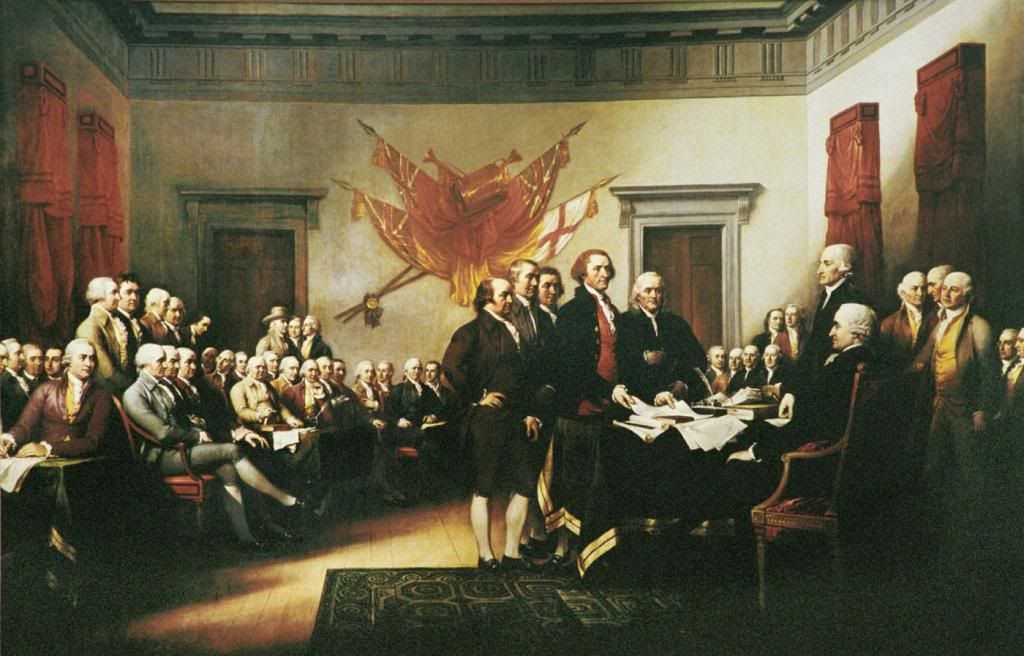
Independence day


"Our lives, our fortunes, our sacred honor"
by Rush H. Limbaugh, Jr.

It was a glorious morning. The sun was shining and the wind was from the southeast. Up especially early, a tall bony, redheaded young Virginian found time to buy a new thermometer, for which he paid three pounds, fifteen shillings. He also bought gloves for Martha, his wife, who was ill at home.

Thomas Jefferson arrived early at the statehouse. The temperature was 72.5 degrees and the horseflies weren't nearly so bad at that hour. It was a lovely room, very large, with gleaming white walls. The chairs were comfortable. Facing the single door were two brass fireplaces, but they would not be used today.

The moment the door was shut, and it was always kept locked, the room became an oven. The tall windows were shut, so that loud quarreling voices could not be heard by passersby. Small openings atop the windows allowed a slight stir of air, and also a large number of horseflies. Jefferson records that "the horseflies were dexterous in finding necks, and the silk of stocking was nothing to them." All discussion was punctuated by the slap of hands on necks.

On the wall at the back, facing the President's desk, was a panoply-consisting of a drum, swords, and banners seized from Fort Ticonderoga the previous year.

Ethan Allen and Benedict Arnold had captured the place, shouting that they were taking it "in the name of the Great Jehovah and the Continental Congress!"

Now Congress got to work, promptly taking up an emergency measure about which there was discussion but no dissention. "Resolved: That an application be made to the Committee of Safety of Pennsylvania for a supply of flints for the troops at New York."

Then Congress transformed itself into a committee of the whole. The Declaration of Independence was read aloud once more, and debate resumed. Though Jefferson was the best writer of all of them, he had been somewhat verbose. Congress hacked the excess away.

They did a good job, as a side-by-side comparison of the rough draft and the final text shows. They cut the phrase "by a self-assumed power." "Climb" was replaced by "must read," then "must" was eliminated, then the whole sentence, and soon the whole paragraph was cut.

Jefferson groaned as they continued what he later called "their depredations." "Inherent and inalienable rights" came out "certain unalienable rights," and to this day no one knows who suggested the elegant change.

A total of 86 alterations were made. Almost 500 words were eliminated, leaving 1,337. At last, after three days of wrangling, the document was put to a vote.

Here in this hall Patrick Henry had once thundered: " I am no longer a Virginian, Sir, but an American." But today the loud, sometimes bitter argument stilled, and without fanfare the vote was taken from north to south by colonies, as was the custom. On July 4, 1776, the Declaration of Independence was adopted.

There were no trumpets blown. No one stood on his chair and cheered. The afternoon was waning and Congress had no thought of delaying the full calendar of routine business on its hands. For several hours they worked on many other problems before adjourning for the day.

Much To Lose

What kind of men were the 56 signers who adopted the Declaration of Independence and who, by their signing, committed an act of treason against the crown? To each of you the names Franklin, Adams, Hancock, and Jefferson are almost as familiar as household words.

Most of us, however, know nothing of the other signers.

Who were they? What happened to them?

I imagine that many of you are somewhat surprised at the names not there: George Washington, Alexander Hamilton, Patrick Henry. All were elsewhere.

Ben Franklin was the only really old man. Eighteen were under 40; three were in their 20s. Of the 56 almost half -24- were judges and lawyers. Eleven were merchants, 9 were landowners and farmers, and the remaining 12 were doctors, ministers, and politicians.

With only a few exceptions, such as Samuel Adams of Massachusetts, these were men of substantial property.

All but two had families. The vast majority were men of education and standing in their communities. They had economic security as few men had in the 18th century.

Each had more to lose from revolution than he had to gain by it. John Hancock, one of the richest men in America, already had a price of 500 pounds on his head.

He signed in enormous letters so "that his Majesty could now read his name without glasses and could now double the reward." Ben Franklin wryly noted: "Indeed we must all hang together, otherwise we shall most assuredly hang separately." Fat Benjamin Harrison of Virginia told tiny Elbridge Gerry of Massachusetts: "With me it will all be over in a minute, but you , you will be dancing on air an hour after I am gone.

These men knew what they risked. The penalty for treason was death by hanging. And remember: a great British fleet was already at anchor in New York Harbor.

They were sober men. There were no dreamy-eyed intellectuals or draft card burners here. They were far from hot-eyed fanatics, yammering for an explosion.

They simply asked for the status quo. It was change they resisted. It was equality with the mother country they desired. It was taxation with representation they sought. They were all conservatives, yet they rebelled.

It was principle, not property, that had brought these men to Philadelphia. Two of them became presidents of the United States. Seven of them became state governors. One died in office as vice president of the United States. Several would go on to be U.S. Senators.

One, the richest man in America, in 1828 founded the Baltimore and Ohio Railroad. One, a delegate from Philadelphia, was the only real poet, musician and philosopher of the signers (it was he, Francis Hopkinson - not Betsy Ross who designed the United States flag).

Richard Henry Lee, A delegate from Virginia, had introduced the resolution to adopt the Declaration of Independence in June of 1776. He was prophetic in his concluding remarks:

"Why then sir, why do we longer delay? Why still deliberate? Let this happy day give birth to an American Republic. Let her arise not to devastate and to conquer but to reestablish the reign of peace and law. The eyes of Europe are fixed upon us. She demands of us a living example of freedom that may exhibit a contrast in the felicity of the citizen to the ever increasing tyranny which desolates her polluted shores. She invites us to prepare an asylum where the unhappy may find solace, and the persecuted repost. If we are not this day wanting in our duty, the names of the American Legislatures of 1776 will be placed by posterity at the side of all of those whose memory has been and ever will be dear to virtuous men and good citizens."

Though the resolution was formally adopted July 4, it was not until July 8 that two of the states authorized their delegates to sign, and it was not until August 2, that the signers met at Philadelphia to actually put their names to the Declaration.

William Ellery, delegate from Rhode Island, was curious to see the signers' faces as they committed this supreme act of personal courage. He saw some men sign quickly, "but in no face was he able to discern real fear."

Stephan Hopkins, Ellery's colleague from Rhode Island, was a man past 60. As he signed with a shaking pen, he declared: "My hand trembles, but my heart does not."

"Most glorious service"

Even before the list was published, the British marked down every member of Congress suspected of having put his name to treason. All of them became the objects of vicious manhunts. Some were taken. Some, like Jefferson, had narrow escapes. All who had property or families near British strongholds suffered.

- Francis Lewis, New York delegate saw his home plundered and his estates in what is now Harlem, completely destroyed by British soldiers. Mrs. Lewis was captured and treated with great brutality. Though she was later exchanged for two British prisoners though the efforts of Congress she died from the effects of her abuse.

- William Floyd, another New York delegate, was able to escape with his wife and children across Long Island Sound to Connecticut, where they lived as refugees without income for seven years. When they came home they found a devastated ruin.

- Philips Livingstone had all his great holdings in New York confiscated and his family driven out of their home. Livingstone died in 1778 still working in Congress for the cause.

- Louis Morris, the fourth New York delegate, saw all his timber, crops, and livestock taken. For seven years he was barred from his home and family.

- John Hart of Trenton, New Jersey, risked his life to return home to see his dying wife. Hessian soldiers rode after him, and he escaped in the woods. While his wife lay on her deathbed, the soldiers ruined his farm and wrecked his homestead. Hart, 65, slept in caves and woods as he was hunted across the countryside. When at long last, emaciated by hardship, he was able to sneak home, he found his wife had already been buried, and his 13 children taken away. He never saw them again. He died a broken man in 1779, without ever finding his family.

- Dr. John Witherspoon, signer, was president of the College of New Jersey, later called Princeton. The British occupied the town of Princeton, and billeted troops in the college. They trampled and burned the finest college library in the country.

- Judge Richard Stockton, another New Jersey delegate signer, had rushed back to his estate in an effort to evacuate his wife and children. The family found refuge with friends, but a Tory sympathizer betrayed them. Judge Stockton was pulled from bed in the night and brutally beaten by the arresting soldiers. Thrown into a common jail, he was deliberately starved. Congress finally arranged for Stockton's parole, but his health was ruined. The judge was released as an invalid, when he could no longer harm the British cause. He returned home to find his estate looted and did not live to see the triumph of the revolution. His family was forced to live off charity.

- Robert Morris, merchant prince of Philadelphia, delegate and signer, met Washington's appeals and pleas for money year after year. He made and raised arms and provisions which made it possible for Washington to cross the Delaware at Trenton. In the process he lost 150 ships at sea, bleeding his own fortune and credit almost dry.

- George Clymer, Pennsylvania signer, escaped with his family from their home, but their property was completely destroyed by the British in the Germantown and Brandywine campaigns.

- Dr. Benjamin Rush, also from Pennsylvania, was forced to flee to Maryland. As a heroic surgeon with the army, Rush had several narrow escapes.

- John Martin, a Tory in his views previous to the debate, lived in a strongly loyalist area of Pennsylvania. When he came out for independence, most of his neighbors and even some of his relatives ostracized him. He was a sensitive and troubled man, and many believed this action killed him. When he died in 1777, his last words to his tormentors were: "Tell them that they will live to see the hour when they shall acknowledge it [the signing] to have been the most glorious service that I have ever rendered to my country."

- William Ellery, Rhode Island delegate, saw his property and home burned to the ground.

- Thomas Lynch, Jr., South Carolina delegate, had his health broken from privation and exposures while serving as a company commander in the military. His doctors ordered him to seek a cure in the West Indies and on the voyage he and his young bride were drowned at sea.

- Edward Rutledge, Arthur Middleton, and Thomas Heyward, Jr., the other three South Carolina signers, were taken by the British in the siege of Charleston. They were carried as prisoners of war to St. Augustine, Florida, where they were singled out for indignities. They were exchanged at the end of the war, the British in the meantime having completely devastated their large landholdings and estates.

- Thomas Nelson, signer of Virginia, was at the front in command of the Virginia military forces. With British General Charles Cornwallis in Yorktown, fire from 70 heavy American guns began to destroy Yorktown piece by piece. Lord Cornwallis and his staff moved their headquarters into Nelson's palatial home. While American cannonballs were making a shambles of the town, the house of Governor Nelson remained untouched. Nelson turned in rage to the American gunners and asked, "Why do you spare my home?" They replied, "Sir, out of respect to you." Nelson cried, "Give me the cannon!" and fired on his magnificent home himself, smashing it to bits. But Nelson's sacrifice was not quite over. He had raised $2 million for the Revolutionary cause by pledging his own estates. When the loans came due, a newer peacetime Congress refused to honor them, and Nelson's property was forfeited. He was never reimbursed. He died, impoverished, a few years later at the age of 50.

Lives, fortunes, honor

Of those 56 who signed the Declaration of Independence, nine died of wounds or hardships during the war. Five were captured and imprisoned, in each case with brutal treatment. Several lost wives, sons or entire families. One lost his 13 children. Two wives were brutally treated. All were at one time or another the victims of manhunts and driven from their homes.

Twelve signers had their homes completely burned.

Seventeen lost everything they owned. Yet not one defected or went back on his pledged word. Their honor, and the nation they sacrificed so much to create is still intact.

And, finally, there is the New Jersey Signer, Abraham Clark.

He gave two sons to the officer corps in the Revolutionary Army. They were captured and sent to that infamous British prison hulk afloat in New York Harbor known as the hell ship "Jersey," where 11,000 American captives were to die. The younger Clarks were treated with a special brutality because of their father.

One was put in solitary and given no food. With the end almost in sight with the war almost won, no one could have blamed Abraham Clark for acceding to the British request when they offered him his sons' lives if he would recant and come out for the King and Parliament. The utter despair in this man's heart, the anguish in his very soul, must reach out to each and one of us down through 200 years with the answer: "No."

The 56 signers of the Declaration of Independence proved by their every deed that they made no idle boast when they composed the most magnificent curtain line in history. "And for the support of this Declaration with a firm reliance on the protection of divine providence, we mutually pledge to each other our lives, our fortunes, and our sacred honor."

- Rush H. Limbaugh, Jr.



books

Friday, March 15, 2013

God Gave Us Easter by Lisa Tawn Bergren

Papa bear explains to little bear that Easter is even better than Christmas.  He helps his cubs understand what Easter is all about and why God gave us Easter.  He uses an egg to help him illustrate to Little Cub about Jesus' death and the tomb.  He explains how out of death comes life.  This is a very good book to help start your young one thinking about the true meaning of Easter.  A very good book to use to get questions started.  The illustrations are just a good as the story itself.  I love Lisa's books, they are wonderfully written just geared to children. 


"God loved us so much he wanted us to always be with him too. That’s why God knew he’d need to give us Easter.”  

As Little Cub celebrates Easter with Papa, Mama, and her brother and sister, she begins to ask her papa questions about this very special day of the year.  Papa lovingly explains God’s plans for his children, while taking Little Cub on a memorable walk through her stunning Arctic world, and he shares how Easter came about in clear, simple terms that even the littlest cubs can understand.

free coloring picture
author's website
more information about the book
read an excerpt here

Lisa T. Bergren is the author of over forty books, with nearly two million copies sold. Her work includes children’s books, historical and contemporary fiction, women’s nonfiction, and gift books. A freelance writer and editor, Lisa lives in Colorado Springs, Colorado. She and her husband, Tim, are the parents of three children.


A copy of this book was provided free for this review by WMPG.


books

Saturday, December 1, 2012

Debt-Proof Your Christmas by Mary Hunt


Debt-Proof Your Christmas: Celebrating the Holidays without Breaking the Bank

About the Book

Have a Very Debt-Proof Christmas


By Mary Hunt
978-0-8007-2143-5
$12.99
Paperback
240pages
Pub Date: September 2012
Christmas may be the most wonderful time of year, but it’s also one of the most stressful and most expensive. Americans spend billions, crafting the perfect holiday season complete with lavish meals, new decorations and the latest, greatest gadgets and fashions for everyone on their gift list. Most don’t think about the hefty price tag until the credit card bill comes in January, and many will go thousands of dollars deeper into debt to finance the perfect holiday season.

For anyone who wants to have a less stressful, more joyful holiday season and celebrate without breaking the bank, syndicated personal finance columnist Mary Hunt is here to help.

“Here’s my challenge for you,” writes Hunt. “This Christmas, lock up the credit cards and let me show you how to experience the best Christmas ever with no debt, less stress, and more joy!”

In Debt-Proof Your Christmas Hunt helps readers assess their financial situation, commit to no new debt and think creatively about their gift list. With her guidance, readers will identify what has caused them to overspend in the past and approach this holiday season with a plan and a new attitude toward holiday spending. This just might be the best gift you can give yourself and your family.


Though it may be a little too late to read Mary's book and implement her ideas for this year; however,  start early for the years to come.  Mary gives practical and wonderful advice.  You couldn't ask for more simple ideas.  I'm an easy simple person.  It may take some time to recondition your way of thinking, but Hunt shares many many ideas in her book.  I just can't say enough about how I totally enjoyed reading Debt-Proof your Christmas.  She not only shares ways to make your Christmas debt free, but also ideas for finding bargains, making from your garden, kitchen and putting things in a jar.  Hunt shares ways to make traditions in your family and she even has written ideas from others that have willing shared with her what they do.  This is a book that once you get it you'll have instant ideas right at your finger tips.  You'll grab it every chance you get for reference. 


 Like to have more sneak peak at inside check it out @ CBD

About the Author

Mary Hunt is an award-winning and bestselling author, syndicated columnist and sought-after motivational speaker who created a global platform that is making strides to help men and women battle the epidemic impact of consumer debt. She is founder and publisher of the interactive website Debt-Proof Living, which features financial tools, resources and information for her online members. Her books have sold more than a million copies and her daily newspaper column is nationally syndicated through Creators Syndicate and is enjoyed by hundreds of thousands of Everyday Cheapskate readers. Hunt speaks widely on personal finance and has appeared on shows such as Good Morning America, Oprah, Dr. Phil and Focus on the Family. She and her husband live in California.


Visit NBCNews.com for breaking news, world news, and news about the economy

“Available September 2012 at your favorite bookseller from Revell, a division of Baker Publishing Group.”

A copy of this book was provided in exchange for my honest review by... 


books

Wednesday, July 4, 2012

Tributes...


It's like a tradition for me to watch this beautiful video every 4th.  I love it and I couldn't believe I had not posted it in past years on this blog.  I couldn't find it in my archives.  this is so wonderfully done and you won't be disappointed that you traveled the Grand ol' USA with this video.  


Army 


Navy 


Air Force 


Marines 


Speical forces: Green Berets


Battle Hymn of Republic


our lives, our fortunes and our Sacred Honor....


"Our Lives, our Fortunes, and our Sacred Honor." Our Founding Fathers paid the price for the United States of America.
By Jeff Jacoby, Globe Columnist
Copyright 2000 Boston Globe

On July 2, 1776, the Continental Congress voted 12-0 -- New York abstained -- in favor of Richard Henry Lee's resolution "that these United Colonies are, and of right ought to be, free and independent States."

On July 4, the Declaration of Independence drafted by Thomas Jefferson -- heavily edited by Congress -- was adopted without dissent. On July 8, the Declaration was publicly proclaimed in Philadelphia. On July 15, Congress learned that the New York Legislature had decided to endorse the Declaration. On Aug. 2, a parchment copy was presented to the Congress for signature. Most of the 56 men who put their name to the document did so that day.

And then?

We tend to forget that to sign the Declaration of Independence was to commit an act of treason -- and the punishment for treason was death. To publicly accuse George III of "repeated injuries and usurpations," to announce that Americans were therefore "Absolved from all Allegiance to the British Crown," was a move fraught with danger -- so much so that the names of the signers were kept secret for six months

They were risking everything, and they knew it. That is the meaning of the Declaration's soaring last sentence:

"And for the support of this Declaration, with a firm Reliance on the Protection of divine Providence, we mutually pledge to each other our Lives, our Fortunes, and our sacred Honor."

Most of the signers survived the war; several went on to illustrious careers.

Two of them became presidents of the United States, and among the others were future vice presidents, senators, and governors. But not all were so fortunate.

Nine of the 56 died during the Revolution, and never tasted American independence.

Five were captured by the British.

Eighteen had their homes -- great estates, some of them - looted or burnt by the enemy.

Some lost everything they owned.

Two were wounded in battle.

Two others were the fathers of sons killed or captured during the war.

"Our Lives, our Fortunes, and our sacred Honor." It was not just a rhetorical flourish.

We all recognize John Hancock's signature, but who ever notices the names beneath his? William Ellery, Thomas Nelson, Richard Stockton, Button Gwinnett, Francis Lewis -- to most of us, these are names without meaning.

But each represents a real human being, some of whom paid dearly "for the support of this Declaration" and American independence.

Lewis Morris of New York, for example, must have known when he signed the Declaration that he was signing away his fortune. Within weeks, the British ravaged his estate, destroyed his vast woodlands, butchered his cattle, and sent his family fleeing for their lives.

Another New Yorker, William Floyd, was also forced to flee when the British plundered his property. He and his family lived as refugees for seven years without income. The strain told on his wife; she died two years before the war ended.

Carter Braxton of Virginia, an aristocratic planter who had invested heavily in shipping, saw most of his vessels captured by the British navy. His estates were largely ruined, and by the end of his life he was a pauper.

The home of William Ellery, a Rhode Island delegate, was burned to the ground during the occupation of Newport.

Thomas Heyward Jr., Edward Rutledge, and Arthur Middleton, three members of the South Carolina delegation, all suffered the destruction or vandalizing of their homes at the hands of enemy troops. All three were captured when Charleston fell in 1780, and spent a year in a British prison.

"Our Lives, our Fortunes, and our sacred Honor."

Thomas Nelson Jr. of Virginia raised $2 million for the patriots' cause on his own personal credit. The government never reimbursed him, and repaying the loans wiped out his entire estate. During the battle of Yorktown, his house, which had been seized by the British, was occupied by General Cornwallis. Nelson quietly urged the gunners to fire on his own home. They did so, destroying it. He was never again a man of wealth. He died bankrupt and was buried in an unmarked grave.

Richard Stockton, a judge on New Jersey's supreme court, was betrayed by loyalist neighbors. He was dragged from his bed and thrown in prison, where he was brutally beaten and starved. His lands were devastated, his horses stolen, his library burnt. He was freed in 1777, but his health had so deteriorated that he died within five years. His family lived on charity for the rest of their lives.

In the British assault on New York, Francis Lewis's home and property were pillaged. His wife was captured and imprisoned; so harshly was she treated that she died soon after her release. Lewis spent the remainder of his days in relative poverty.

And then there was John Hart. The speaker of the New Jersey Assembly, he was forced to flee in the winter of 1776, at the age of 65, from his dying wife's bedside. While he hid in forests and caves, his home was demolished, his fields and mill laid waste, and his 13 children put to flight. When it was finally safe for him to return, he found his wife dead, his children missing, and his property decimated. He never saw any of his family again and died, a shattered man, in 1779.

The men who signed that piece of parchment in 1776 were the elite of their colonies. They were men of means and social standing, but for the sake of liberty, they pledged it all -- their lives, their fortunes, and their sacred honor. We are in their debt to this day

Read:
"Our Lives, Our Fortunes, and Our Sacred Honor" by Paul Harvey


We are in great NEED of this in our country today


zwani.com myspace graphic comments

Thursday, November 24, 2011

Thanksgiving in Early America


Thanksgiving in Early America
by Elaine Marie Cooper

When we sit down at our Thanksgiving meal this month, we’ll be recreating a celebration that is as old as our country: sharing food with loved ones while thanking the God Who has provided the abundance.

While we understand that the First Thanksgiving was celebrated here by the Mayflower survivors along with the Indians that had helped them, the first official proclamation that was decreed to celebrate such a holiday was in 1777. It was a recommendation to the thirteen states by the Continental Congress to set aside December 18th that year as a “solemn thanksgiving” to celebrate the first major victory for the Continental troops in the American Revolution: the Battle of Saratoga.

The Battle of Saratoga has significant interest for my own family since one of my ancestors was a soldier there. But he was not on the American side—he was a British Redcoat. After surrendering to the Americans, he escaped the line of prisoners and somehow made his way to Massachusetts and into the life and heart of my fourth great-grandmother. *SIGH* L’amour!

This family story was the inspiration for my Deer Run Saga that begins in 1777 with The Road to Deer Run. There is an elaborate Thanksgiving meal scene in this novel as well as in the sequel, The Promise of Deer Run.

Some may wonder why such detail was afforded this holiday in my novels set in Massachusetts, while Christmas is barely mentioned. The reason is simple: Thanksgiving was the major holiday in the northern colonies, with Christmas considered nothing more special than a workday. According to Jack Larkin in his book, The Reshaping of Everyday Life, “The Puritan founders of New England and the Quaker settlers of Pennsylvania had deliberately abolished (holidays) as unscriptural.”

But Thanksgiving was begun as a way to give thanks to God for His provision. It usually began with attending church services in the morning, followed by an elaborate feast in the afternoon. The food for this meal was prepared for weeks in advance.

Since the individual state governors chose their own date to celebrate the holiday, it was theoretically possible for some family members—if they lived in close proximity—to celebrate multiple Thanksgiving meals with family and friends across state borders. The dates chosen could be anywhere from October to December, according to Dennis Picard, Director of the Storrowton Village Museum in West Springfield, Massachusetts.

Chicken was most commonly served, said Picard, as it was readily available in the barnyard. And the oldest woman in the home had the honor of slicing the fowl for dinner.

Pies were made well in advance of the holiday and stored and became frozen in dresser drawers in unheated rooms.

“I like the idea of pulling out a dresser drawer for, say, a clean pair of socks, and finding mince pies,” said Picard, tongue in cheek.

Indeed!

Have a BLESSED Thanksgiving!

Elaine Marie Cooper grew up in Massachusetts but now lives in the Midwest with her husband, her three dogs and one huge cat. She has two married sons and triplet grandchildren who are now one years old. The Promise of Deer Run is dedicated to the triplets and to veterans who suffer from Post Traumatic Stress Disorder.Elaine has been a magazine freelance writer for many years, and is a regular contributor to a blog on the Midwest called The Barn Door (www.thebarndoor.net) and a blog on Christian living called Reflections In Hindsight (ReflectionsInHindsight.wordpress.com). She is the author of The Road to Deer Run and the sequel, The Promise of Deer Run. Prior to becoming an author, Elaine worked as a registered nurse.

Visit Promise of Deer Run blog tour here.

A copy of this book was provided by...


books

Thanksgiving

Myspace Graphics

Monday, October 31, 2011

Gruesome Halloween by Joy Cowley


 Not too spooky, not too scary just right for a fun Halloween read.  Gruesome Halloween is a cute book just right for the special little ghost and gobblins one to learn what it is like for the Gruesome family as they disguise themselves as humans and go to a costume party on Halloween night.  It is so cute.  I really like Cowley's books for kids.  They are just at the right level.  Your child can read it or you may read it to them.  Written for 1-2 readers to comprehend. 

 Get more information about this book here.

Hameray Publishing Group is dedicated to providing innovative literacy materials to today's educators that adhere to the Common Core State Standards. Combining research-based methods with cutting edge content, Hameray has developed products for struggling readers, as well as those reading at grade level.

An ecopy of this book was provided by Hameray Publishing and the author for this review purpose.

books

Monday, July 4, 2011

Beautiful America


It's like a tradition for me to watch this beautiful video every 4th.  I love it and I couldn't believe I had not posted it in past years on this blog.  I couldn't find it in my archives.  this is so wonderfully done and you won't be disappointed that you traveled the Grand ol' USA with this video.